
Airtightness Tests: Compartment vs Whole
It’s natural for people to look for more cost-effective ways to do things. In the case of air tightness testing, what may seem like a cheaper alternative often comes with hidden complications. This article is written to help builders, ESD consultants, or interested technically minded people to understand the downsides of testing compartments rather than the whole building.
What is the purpose of airtightness testing?
When we consider air tightness testing to be done for whatever the reason, this is the first question we should be thinking about.
- Are we testing to understand the overall permeability of the building envelope?
- Are you comparing the quality of facade installation to factory testing standards, or assessing core and facade leakage?
- Are we testing to confirm weather protection from ingress of water during extreme weather events?
- Or is it for all of the above?
Before we discuss the testing options, it is crucial to understand that the Australian construction industry has not yet come to grips with the principle of a ‘building as a system.’ Any building, large or small, needs to be treated as a complex assembly with thousands of components and a range of mechanical and passive systems, all working together. A change in one part of the system inevitably affects others, including indoor air quality and energy performance.
Consider the analogy of a car engine: changing the air intake alone won’t optimise fuel efficiency. You may also need to upgrade the spark plugs, carburetor, or timing belt. Similarly, improving or isolating one section of a building’s airtightness can actually cause imbalance in other systems, compromising overall performance. The building may have many different components and other areas like elevator shafts, ductwork, external doors, or a leaky roof section. Just testing one part will not tell the complete story for the whole building.
What types of testing can be performed on a building?
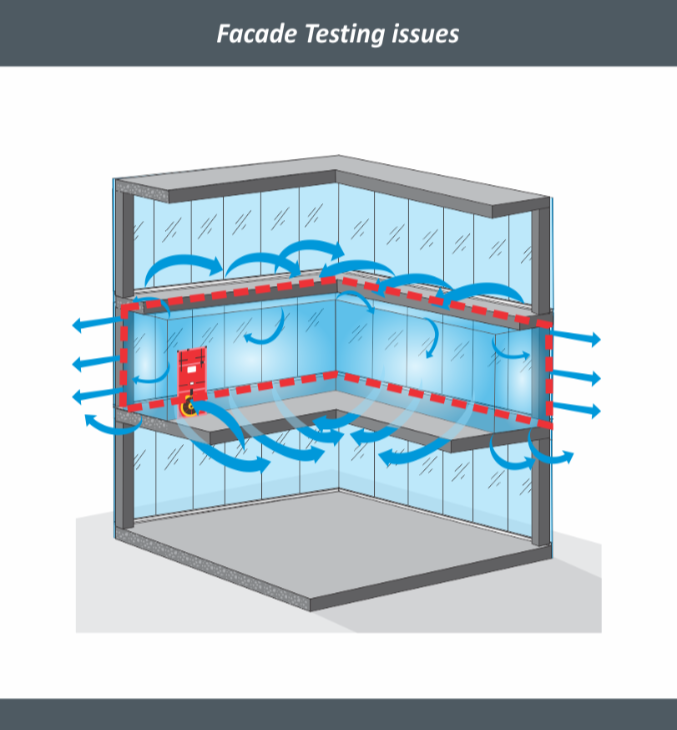
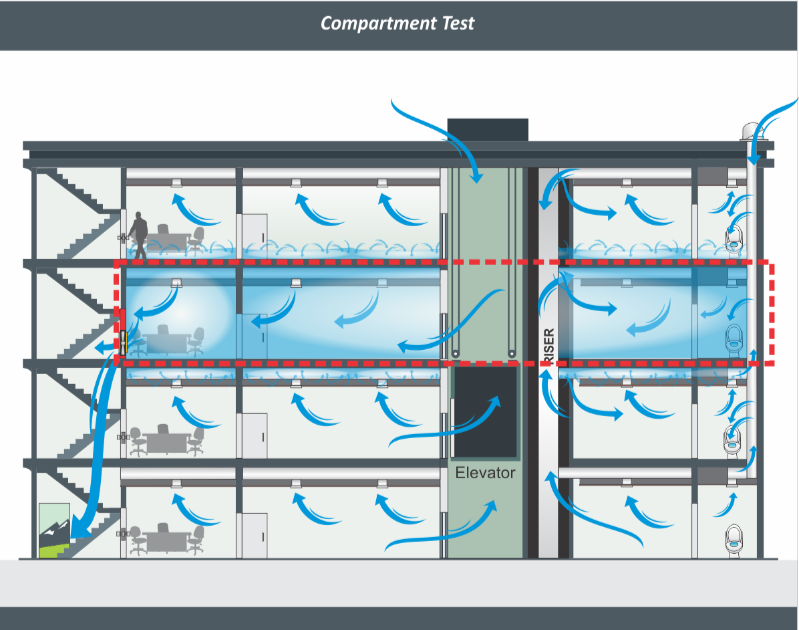 Compartment blower door testing is testing a part of the building envelope. Facade testing is also considered compartment testing. Only the surface area connected to the outside is to be used to determine the leakage rate. However, results include leakage internally through the building as well as via the external surface area. For example, an intermediate floor can only take into account the facade but will leak air from the floors above and below. This results in compromised data. Compartment testing should include multiple different types of areas, top floor, ground floor and intermediate. This method of testing is not detailed in any international standards.
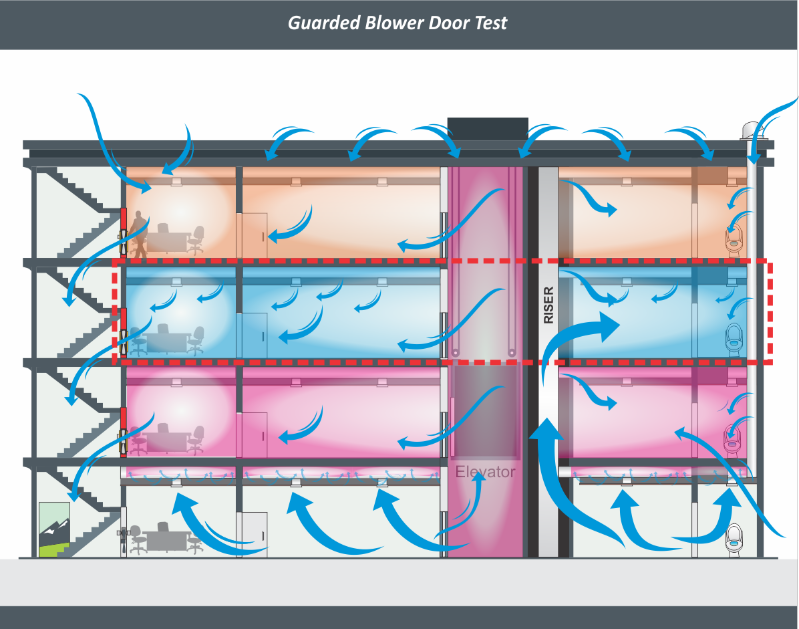
Guarded compartment blower door testing is where a compartment is tested, but surrounding compartments are pressurised at the same pressure to cancel out leakage going internal to the building envelope. Once again, only envelope area connected to outside is counted in the leakage rate. Guarded blower door testing can account for up to 20% of the building. However, it can experience similar flaws to compartment testing if it is not planned out well. Core leakage can be inadvertently cancelled out and not measured. Additionally, guarded blower door testing requires more blower door fans and detailed planning. It is discussed in international standards.
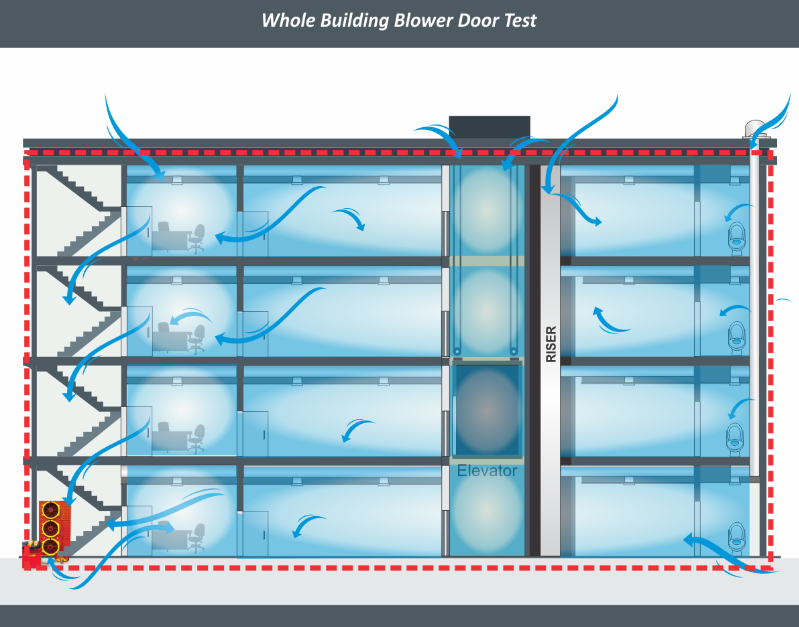 Whole building blower door testing enables the builder to focus only on the building envelope and enables a much more straightforward and reproducible test methodology. It does, in most cases require, more fan power. Check out this article to find out what the building envelope includes.
The pros and cons of compartment are testing…
Though it may be cheaper initially, compartment or face testing can lead to:
- Misleading results due to leakage inside the internal structure (e.g. behind plaster, between floors, within façade cavities).
- Non-representative surface areas used for calculations, undermining Green Star or other rating targets.
- Wasted remediation works that do not improve the effectiveness of the actual building envelope.
- Surface areas in the compartment zones that have been given special attention by trades, resulting in worse performance across the rest of the building.
- Future full-building tests revealing poor performance, leading to costly retroactive fixes.
Temporary enclosures used in face testing often do not seal the true air, making test results ultimately invalid.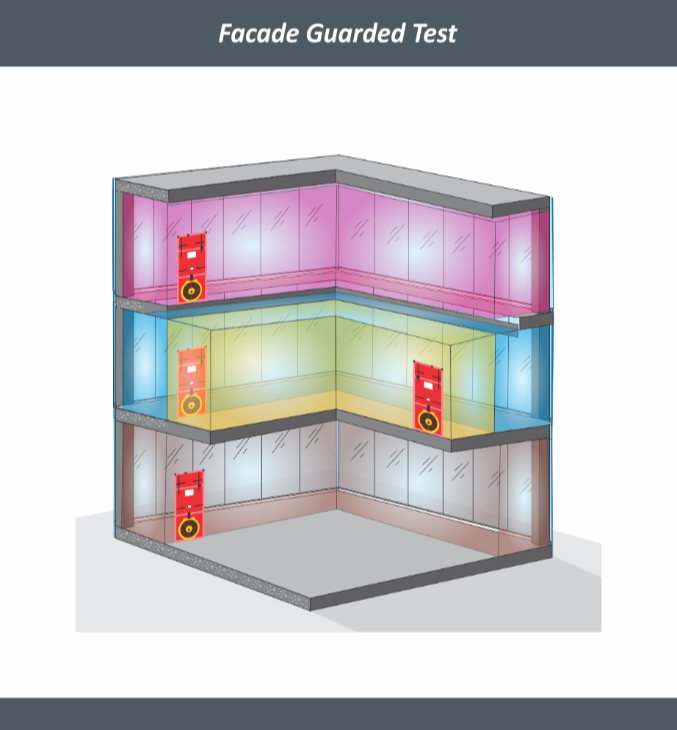
Where compartment testing does help
- Smoke wall testing – These are designed to create airtight barriers between compartments, but they are very rarely verified.
- Smoke leakage visualization – To identify leakage pathways throughout an area that may be applicable across the rest of the building. It is also helpful to educate and demonstrate.
- Water ingress testing – Validates the weatherproofing effects under pressure conditions that might be experienced in reality.
Curtain wall testing
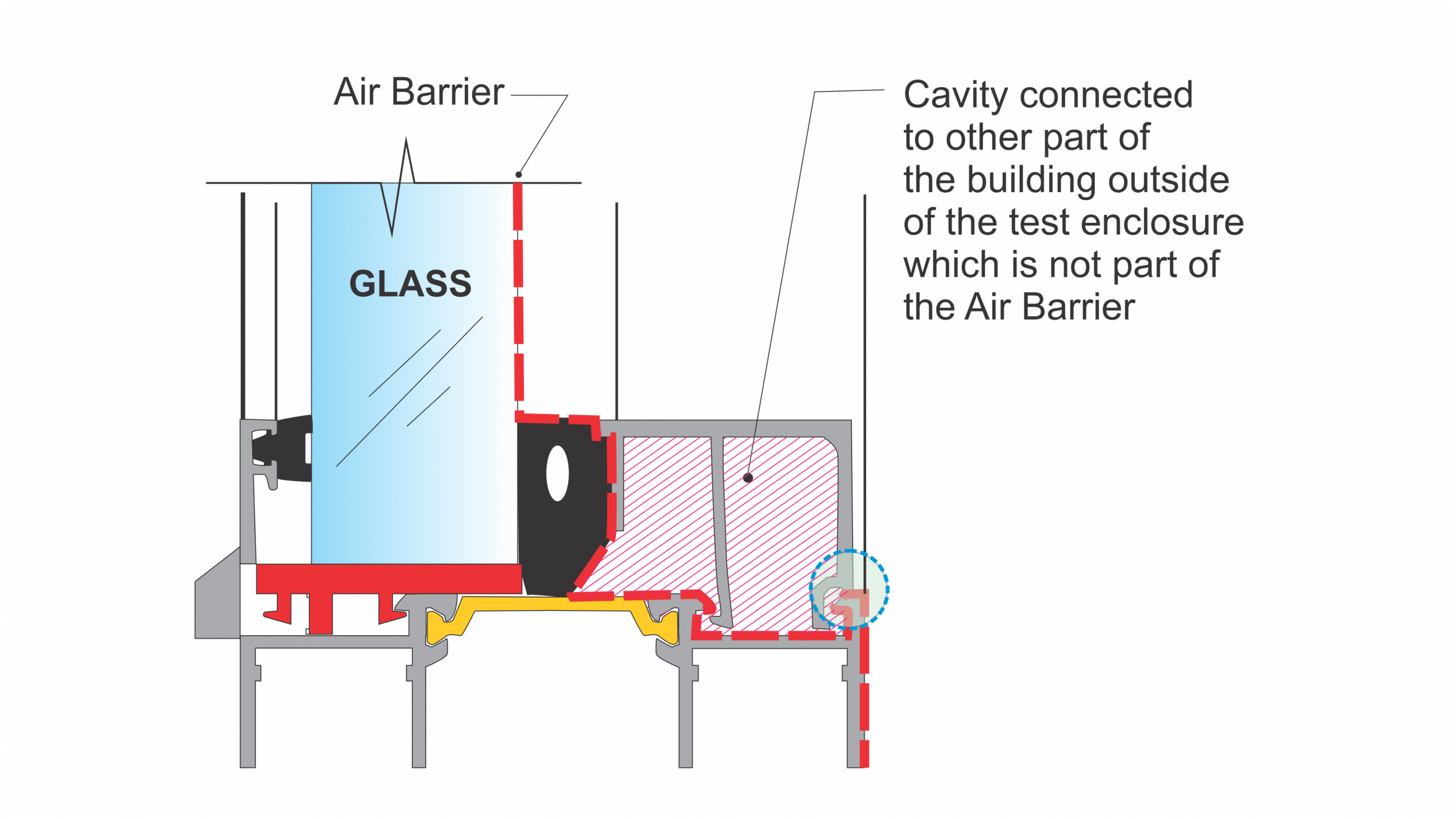
This curtain wall will perform very well in a whole building air leakage test but may fail in an in-situ façade test. This system creates an efficient air barrier at the red dotted line, meaning minimal air is expected to get to the outside of this curtain wall detail. But during an in-situ façade test, the cavity highlighted in purple will be acting as a path to the area outside of the temporary test chamber. This will indicate leakage in the test unless temporarily sealed off. Although window facades may meet their laboratory-tested leakage limits (2.8 m³/h/m²@50 Pa), in-situ façade tests can misrepresent performance by including air paths not part of the designed air barrier.
Stakeholder impacts
For Building Owners
With compartment testing, the actual leakage rate of the whole building is not tested. The owner risks paying for work that doesn’t deliver long-term energy or performance benefits.
For Builder
To meet Green Star points, airtightness must be consistent across all floors. Compartment testing demands the builder caulking and sealing every detail, with any inconsistency invalidating the effort. In many cases, builders who pass compartment tests may still fail whole-building tests.
Final thoughts
Airtightness testing in a building only adds value if action is taken to improve the building envelope. Testing alone does not accomplish this. If compartment testing is chosen for a building, this remediation work is made significantly more difficult. In the end, you may lose money through retesting, wasted sealing efforts, and unmet energy performance expectations. Internal building envelopes are extremely complicated with ducts, risers, smoke seals, window details, and elevator shafts. If the testing methodology is not appropriate to identify where the important problems in the building envelope are, it is not worth using.
The least risky and most cost-effective strategy is to design and build for airtightness from the start. Then, the best way to verify these efforts is to use a whole building blower door test.
Case study of a building air tightness tested in Melbourne
| Level 1 Compartment 3 Fan * | 3.7m3/h/m2@50Pa | Building/floors in fire mode, bathroom ventilation taped up |
| Level 2 Compartment 3 Fan * | 18.1m3/h/m2@50Pa | Building/floors in fire mode, bathroom ventilation taped up |
| Level 3 Compartment 3 Fan* | 19.8m3/h/m2@50Pa | Building/floors in fire mode, bathroom ventilation taped up |
| Level 4 Compartment 3 Fan* | 18.4m3/h/m2@50Pa | Building/floors in fire mode, bathroom ventilation taped up |
| Level 5 Compartment 3 Fan * | 5.3m3/h/m2@50Pa | Building/floors in fire mode, bathroom ventilation taped up |
| Average Whole building Testing with compartment testing * | 13m3/h/m2@50Pa | Average Leakage rate in a case study |
| Whole Building Blower Door Test, 5 Fan Test | 5.2m3/h/m2@50Pa | Building in fire mode, all dampers closed off |
^ The table above shows a recent actual case study of a commercial building air tightness test in Melbourne. Note the huge difference in leakage rate from overall leakage from a compartment test compared to a whole building airtightness test.
Guarded blower door testing can be extremely complicated, so important you get an experienced contractor to conduct this type of testing on a super large building. Contact us for more information or a testing methodology.
Check out this video on blower door testing in large buildings:
Authored by Joseph Cheung & John Konstantakopoulos
With contributions by Jan Brandjes


