
Duct Cleaning or Duct Testing?
Residential ducts can represent a great opportunity for improving energy use and air quality performance in the home. Excessive air leakage, lack of insulation, and improper balancing are the causes of poor performance in Australian homes.
Simple improvements in energy efficiency of residential ducted heating systems
- One of the key ways to improve the effectiveness of your ducted heating system is by keeping the system as balanced as possible. Closing off rooms that aren’t in use by closing doors that have supply outlets can restrict air flow from that outlet getting back to the air handler, which then allows the air handler to draw air from somewhere else (outside).
- If doors are kept closed in a home, consider installing a door grill vent available from our Tighthouse website. Do not block off outlets in unused rooms, as most ducted heating systems are designed to warm the whole home, not just part of it.
- Ensure your return air supply is as airtight as possible. Watch our video at the bottom of this page.
Common problems that can occur in duct systems.
- Building envelope holes on the return air side, as shown in the video at the bottom of this page, can create several problems:
- Cause a net loss of air into the house from outside. A state of depressurization occurs in the main area connected to the return outlet, which increases the potential for backdrafting internal hot water heaters and furnaces should they exist inside the building envelope.
- Dust-laden air also makes its way in, making it difficult to keep the building clean.
- Return air leaks in a wall cavity connected to under the house and/or the roof area will draw dirty air into the duct system, decreasing the performance of the air handler and adding nutrients to mold, mildew, and bacteria in the duct system.
- Supply ductwork leakage can make rooms uncomfortable.
- Conductive losses will occur where ducts run in the roof area or under a house. The loss can be quite significant depending on the temperature differential, as ducts are basically part of the building envelope.
How we check the air tightness and efficiency of duct systems.
- We can measure the air flow from an outlet, with the use of a flow hood. It can indicate if there is a balancing issue or a leaky supply duct.
- We prepare all the outlets of a ducted heating system, and then we retrofit a fan to the return air outlet, where we depressurize the ducts to measure a leakage rate.
Duct Cleaning or Duct Testing?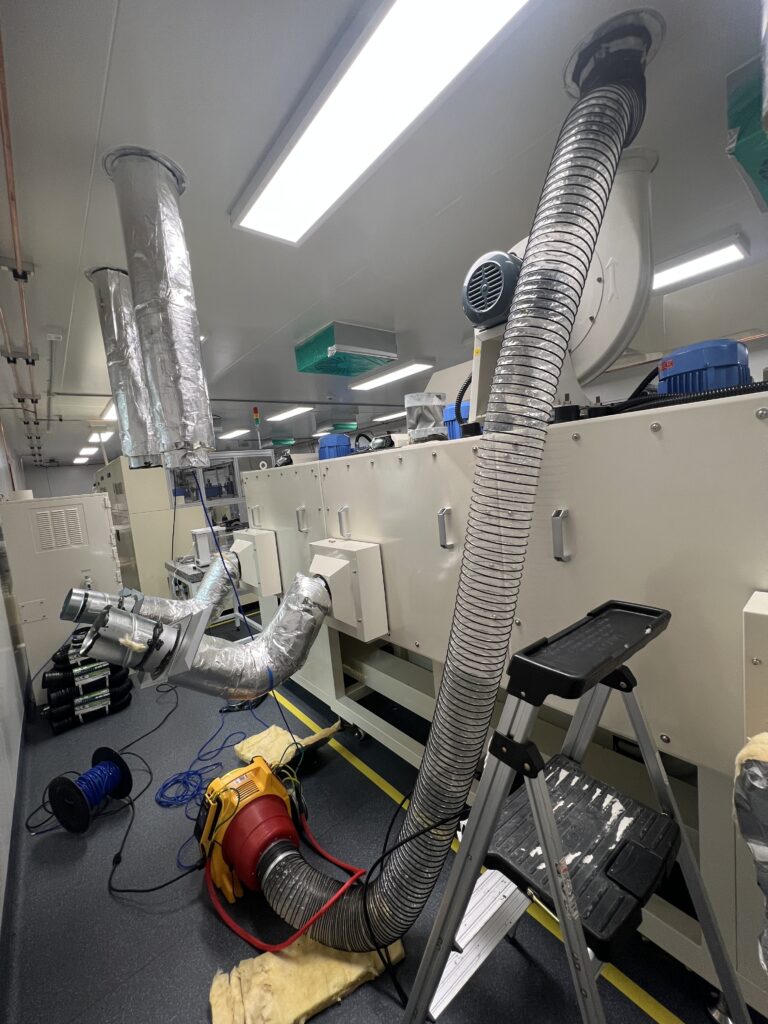

Duct cleaning in America has been researched, and it provides no measurable difference in air quality. Once dirt sticks to the inside of ducts, it stays there for good. Below are some statements made by various organizations:
- From Canada Mortgage and Housing Corporation:
- “In the 1990s, duct cleaning research conducted by Canada Mortgage and Housing Corporation and the US Environmental Protection Agency tested house and duct performance before and after cleaning. Researchers observed little or no discernible differences in the concentrations of house airborne particles or in duct air flows due to duct cleaning.”
- From Indoor Air 2002 (1C6o5 on page 25):
- “Duct cleaning had no measurable effect on supply air quality.”
- From the EPA:
- “The results of the particle mass measurements suggest that… the airborne concentrations before and after cleaning were not substantially different…” Before you choose to clean out your ductwork, consider testing them for airtightness so that less dust/moisture can get inside them in the first place.
Before you choose to clean out your ductwork, consider testing them for air tightness so that less dust/moisture can get inside them in the first place.
http://www.epa.gov/iaq/pubs/airduct.html
Contact us for testing your duct work for air tightness.
Here is a common flaw in residential Ducted heating systems in Melbourne Australia


