
How Blower Door Testing Works
Estimated reading time: 3 min

How Our Calibrated Fan’s create flow and Fan Pressure
When the fan is turned on, air starts moving through the fan housing. In order for the air to be pulled through the holes on the inlet side, there must be suction. The rotating fan blade creates a suction pressure (which is also called Fan Pressure) between the inlet opening and the fan blade.
Range Rings and Plates are installed on the inlet side of the fan housing to artificially restrict flow, control the amount of air going through the fan, and thus control the Fan Pressure.
An analogy
The purpose of controlling flow through the fan is to measure different leakage ranges. Restricting airflow is important because it enables you to measure both smaller and larger holes. For example, measuring how much water fits in a cup using a swimming pool is impossible.
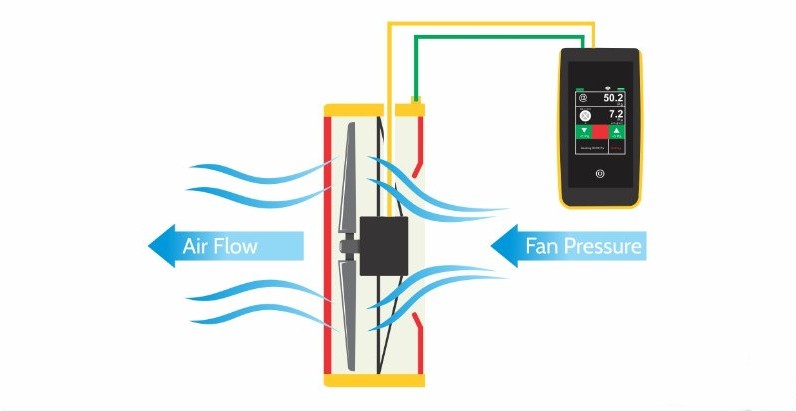
By measuring the Fan Pressure developed across the fan housing, and knowing the size of the hole(s) in the installed Range, we can calculate the volume of air moving through the fan. The area being pressurised will exert pressure at the gauge’s green port, which will be picked up and included as part of the measured pressure difference.
Our self-referencing fans eliminate the need for adjusting Fan Pressure measurements by measuring the pressure difference directly at the fan inlet, with both the green and yellow tubes connected to either side of the fan inlet. With our self-referencing fans, both the yellow and green tubes are connected between the fan and the gauge, and there is no compensation for room pressure.
Multifan tests
The gauges are each connected to a fan, communicating with a computer via IP/Wi-Fi. The computer can capture data from up to 24 fans, enabling leakage measurement in extremely large buildings. Each one of our fans can move up to 14,000 m³/h at 50 Pa when completely unrestricted.


