
Ultrasonic Air Barrier Integrity Auditing
 When aiming to build airtight, the true magic isn’t in the air tightness test itself — it’s in the building design, consistent quality assurance (through air barrier integrity auditing) during construction, and appointing an Airtightness Champion to oversee the process.
Why Air Barrier Integrity Auditing Matters
Air barrier integrity auditing is essential for ensuring that airtightness targets are met efficiently. The key benefits of this process include:
- Precisely locating air leakage issues.
- Verifying the correct air barrier materials are being used for long-term performance.
- Providing timely reports, allowing remediation before finishes are applied.
- Capturing photographic evidence of remediation work.
- Identifying discontinuities in the air barrier at building junctions and façades using ultrasonic technology.
- Recommending compliant remediation solutions in line with the Australian Building Code.
If a QA process is not conducted regularly at key intervals during construction, airtightness targets can become a very expensive exercise. Remediation works that happen after construction can have the potential to not last the test of time. Or they may not even be possible due to safety.
Location, Location, Location
Commercial Buildings can be large and complicated, so it is important that plans are marked up with problematic details. If trades cannot find issues, they just won’t fix them. If issues cannot be relocated to verify remediation, then the whole process of air barrier integrity auditing is rendered ineffective and pointless.
Verification of building materials
In some circumstances, building materials specified for the air barrier may be inadvertently costed out, or supplied with an inappropriate product. Certain tapes or sealants may not be compatible together or may react undesirably when exposed to environments during construction. It’s important to catch these issues during construction so that they can be repaired in a timely manner before finishes.

 Report turnover
Projects can move extremely fast, and it is not uncommon for the fit-out to begin before service risers are complete. Once an inspection is conducted, a report must be issued with all the location details marked off an up-to-date floor plan. Additionally, it should include recommended fixes and dimensions of the issue, with the direction of how the air barrier should be continued.
Photo evidence
Photos of issues should be marked up to clearly articulate to trades the whole that must be closed in. Airtightness is not always obvious.
Troubleshooting during construction
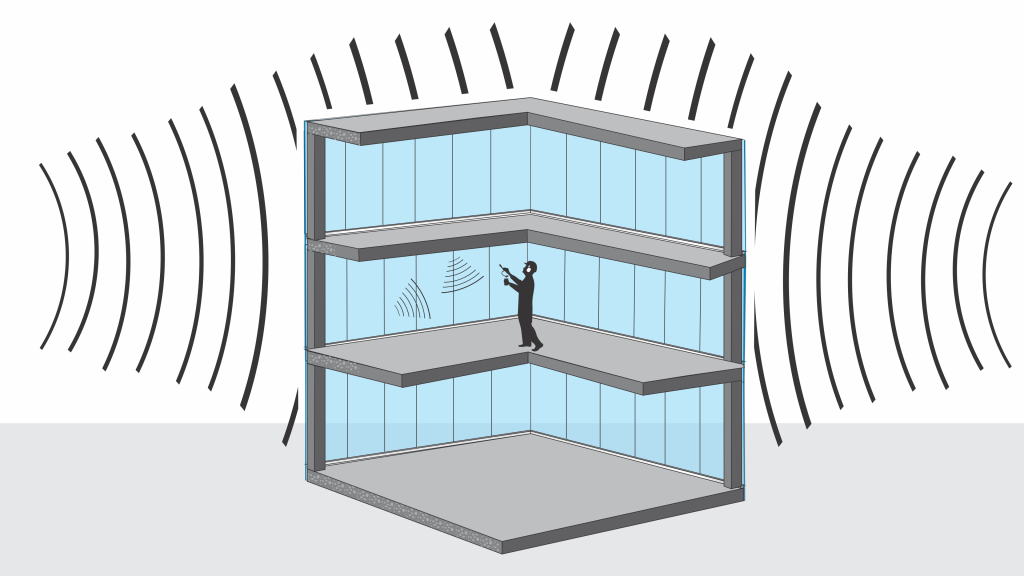
Troubleshooting and confirming air leakage through the air barrier when the building is under construction is difficult. There are technologies available to help confirm non-obvious gaps in building elements. Ultrasonic sound auditing can add significant value.An array of ultrasonic transmitters which generate ultrasonic waves are set up on the outside. This makes it possible to find gaps in curtain wall facades, leaks through building elements, door frames/window frames and window/door seals, even ducts and plenums.
 The ultrasonic detector picks up ultrasound via a microphone and converts the inaudible ultrasound into an audible frequency and in some circumstances overlays the frequency emission location on top of a visual image with a representative highlighted colour. A visual representation is bundled together using a directional array of receivers capable of picking up ultrasonic sound waves while suppressing other noise and outputting onto an image. When auditing ultrasonic sound gets louder the closer you get to the leak and is quickly muffled as it moves through the air. The ultrasonic leak detection can pinpoint even the smallest leaks in a partly constructed building, which is the most economic time to organise a solution.

Recommended Remediation
During construction, drawings sometimes miss air barrier continuity. Different materials that make up the air barrier have different surfaces. Therefore, different products need to be used depending on the circumstances to ensure the longevity of the air barrier over the building’s lifetime.
Air barrier integrity auditing is a critical part of building commissioning. An engaged airtightness coordinator coupled with good building design and detailing, makes airtightness targets like PassiveHouse achievable and economical.


