
BCA and Air Tightness: EM0017
How can we make sense of the mismatch between real-world building performance and regulatory requirements? In this article, we explore how a building’s form and surrounding weather conditions render the use of Air Changes per Hour (ACH) ineffective for assessing air tightness in commercial buildings.
BCA Infiltration Requirements
The Building Code of Australia (BCA) specifies the following infiltration rates for energy modelling:
-
(aa) For a perimeter zone with a depth equal to the floor-to-ceiling height, when the pressurisation plant is operating: 1.0 ACH
-
(bb) For the entire building when the pressurisation plant is not operating: 1.5 ACH
These two clauses are highly ambiguous and leave room for interpretation. Let’s unpack some key oversights.
Please note that some of these effects are almost impossible to model, which throws a massive spanner in the works. EM0017 Revision 1 attempts to address this gap by deriving a permeability rate for commercial buildings using the ATTMA blower door testing methodology.

Not taken into consideration in the BCA, our calculator attempts to quantify this.
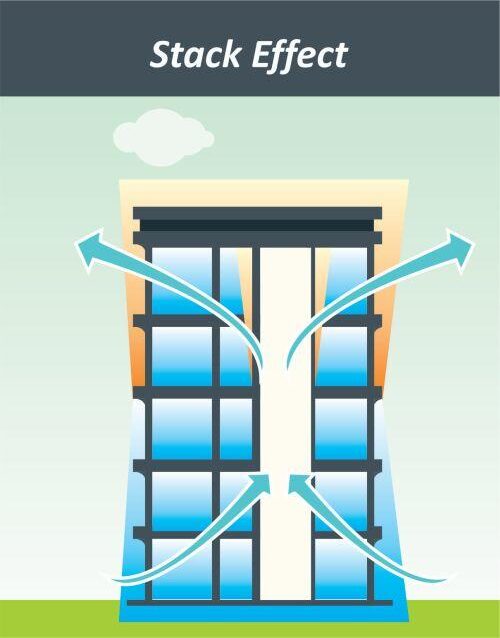 Not addressed in the BCA and not reflected in our calculator. Quite difficult to accommodate, due to the lack of understanding of how big the hole is at the top and bottom of the building, as well as in between floors.
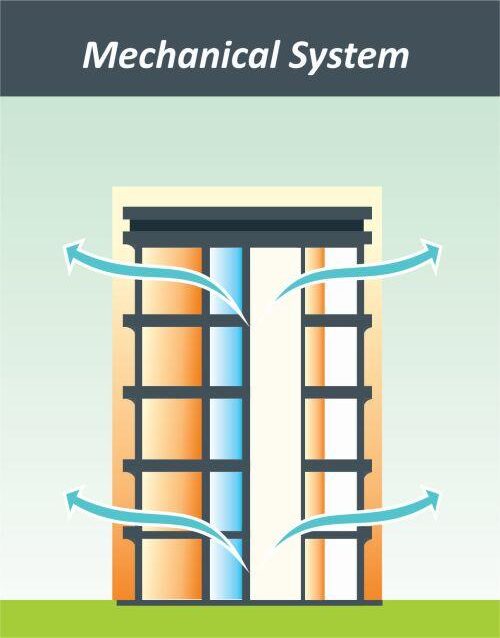 Not addressed in the BCA, but if duct work is done to Australian standards, EM0017 will be grown to include HVAC Leakage energy losses simplistically.
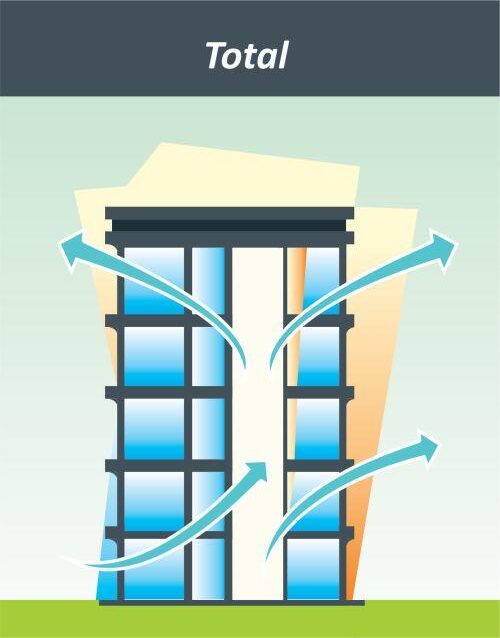
Air leakage in the building envelope can get extremely complicated depending on design, environmental conditions outside, build quality inside, and HVAC duct air tightness. It’s a complex beast, and some serious energy savings can be realised, from focusing on improving the performance of a building envelope and how airtight the HVAC system connects to the building envelope.
To improve this lack of information in the BCA, some ESD consultants have attempted to improve specifics by including additional information into their specification which references ATTMA as a testing guide. It does not help to add detail because in their specification they still reference unrelated measuring units with 1.5ACH(ACH) @ Ambient (plant not in operation) and 1.0ACH on perimeter zones with plant running.
As a comparison
-
ATTMA: Requires all HVAC systems to be turned off. All vents and intakes must be sealed to isolate the building envelope. The permeability rate is tested at a pressure differential of 50 Pa.
-
BCA: Refers to ACH at ambient conditions with plant off—but with openings exposed to external weather pressures.
Why ACH @50Pa Fails for Large Buildings
There is a good reason why ACH@50Pa is not used to understand air leakage in commercial buildings in ATTMA. As the size of the building increase, the volume increases faster than the surface area. Two buildings with identical permeability rates and construction could show vastly different ACH values. In a residential setting ACH can work quite well, but it’s still not as accurate as a permeability rate (m³/h/m² @ 50 Pa) when it comes to comparing apples to apples. Because the BCA uses ACH@ambient as its reference, you can’t reliably translate it into the leakage rate that ATTMA uses. In fact, using ACH at ambient pressure to derive a permeability rate becomes increasingly unreliable for buildings over 30,000 m³, which could equate to a leakage area of 12 m².
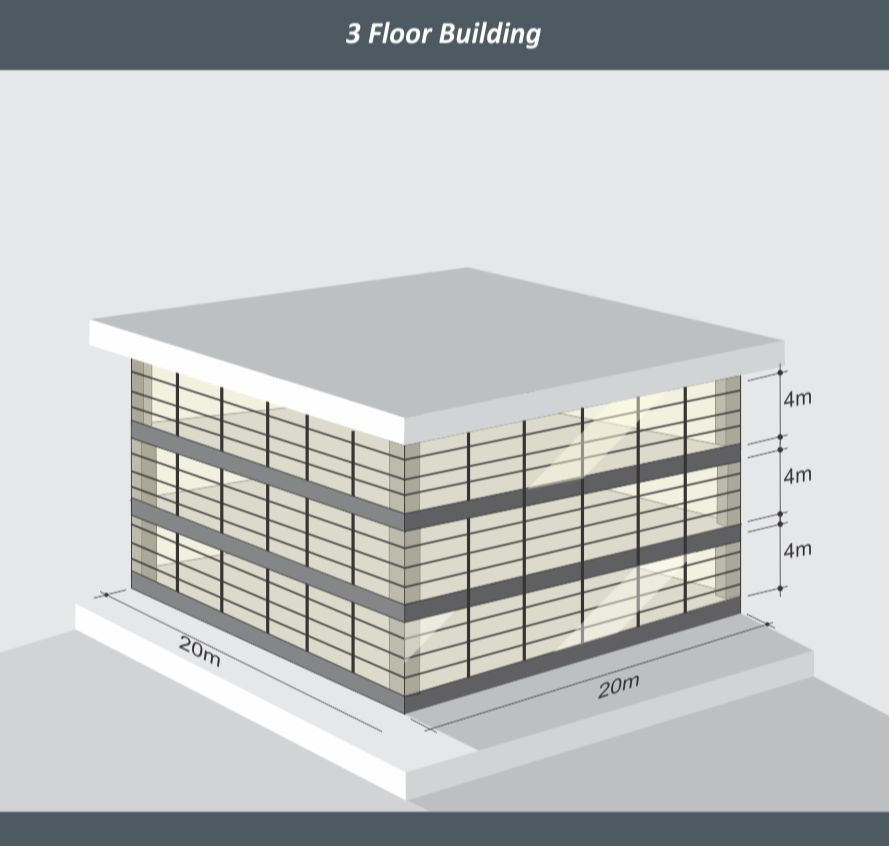
| Building Name | Width Length | Number Floors | Volume | Perimeter Volume Zones | Envelope Surface Areas | After Hours Permeability m3/h/m2@50Pa | Plant operation permeability m3/h/m2@50Pa | Size of Hole in the building using ELA 4Pa |
|---|---|---|---|---|---|---|---|---|
| Small building | 20 | 3 | 4800 | 3648 | 1760 | 14.6 | 16.8 | .54 m2 Hole |
| Typical Suburban Office | 50 | 4 | 40000 | 18832 | 8200 | 30.8 | 18.6 | 3.2 m2 Hole |
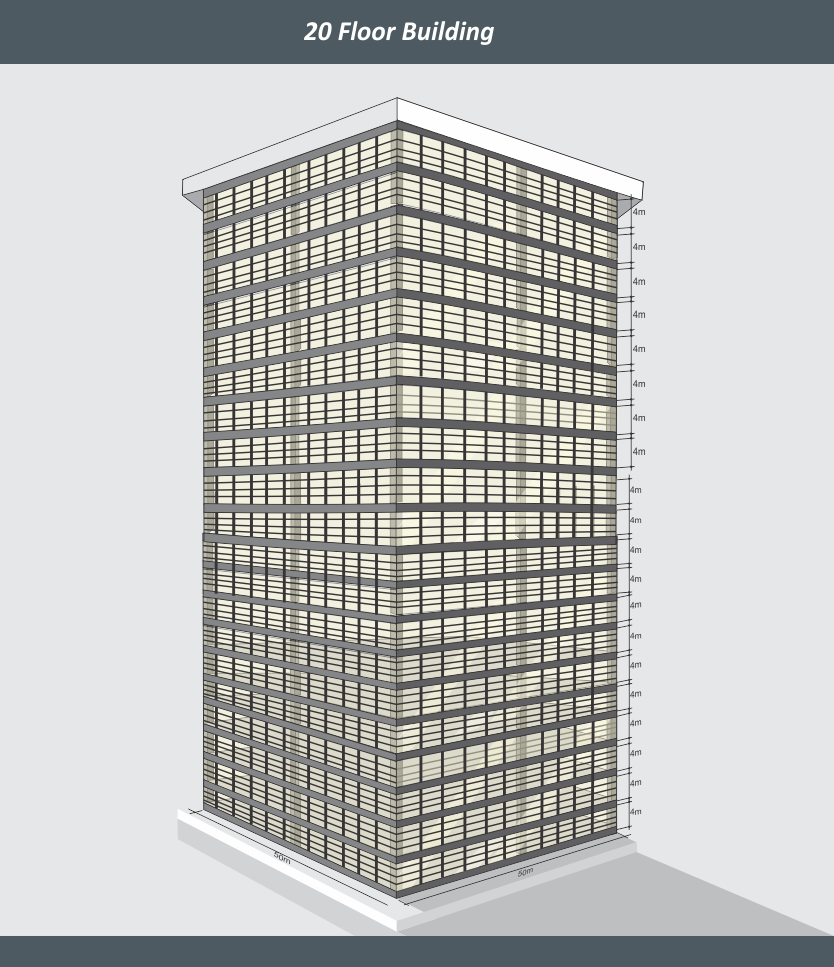
| CBD Office | 50 | 20 | 200000 | 65936 | 21000 | 54.8 | 25.4 | 11.2 m2 Hole |
| Melbourne Central | 55 | 58 | 701800 | 198148 | 57090 | 70.1 | 28.1 | 33.767 m2 Hole |
Note the difference in permeability rate with plant running and not in operation.
Here is an excerpt of a specification used in Australia that uses BCA in conjunction with ATTMA as a guide.
Building Sealing
All heating and cooled spaces (other than spaces defined by BCA Provision J3.1) shall be sealed in accordance with the requirements of the current version of the BCA Part J3 ‘Building Sealing’ and to the degree necessary to reduce air leakage through the building envelope to a rate of:
- 1.0 air change per hour (AC/hr) for perimeter zones of depth equal to the floor-to ceiling height when pressurising plant is operating; and
- 1.5 AC/hr for the whole building when pressurizing plant is not operating.
The term ‘building envelope’ in this context shall be as defined by the BCA: ‘The parts of a building’s fabric that separate a conditioned space or habitable room from the exterior of the building or from a non-conditioned space.’
All sealed buildings shall be suitably pressure tested to adequately prove performance in accordance with BCA Part J3 ‘Building Sealing.’ Guidance on an appropriate procedure for determining building sealing effectiveness is provided in the Air tightness Testing and Measurement Association Technical standard L2 – Measuring air permeability of building envelopes, (Non-Dwellings) Oct 2010 Issue. (Pressure testing for the building sealing shall generally be carried out irrespective of building size.
Using wind only Efficiency Matrix EM0017 Revision 1, attempts to predict a permeability rate. To determine the pressure differential between inside and outside we use a default of 4Pa, the standard adopted in Europe. In some locations of Australia higher winds may be present which means that this number should be revised upwards. Understanding the pressure with which an HVAC system operates at is a tough question also, we have assumed a positive pressure of 2Pa to prevent infiltration. These values can be adjusted for local wind conditions and building characteristics.
Problems with BCA Requirements
1.0 ACH for perimeter zones with pressurising plant in operation.
- What pressure does the HVAC operate with? It is undefined.
- What is the ambient pressure? Varies with building height, external temperatures, and wind the structure is exposed to.
- 21 degrees can be assumed for internal temperature.
1.5 ACH for the whole building when pressurizing plant is not in operation
- Are HVAC dampers still open to outside? Or is it ACH@ambient with the building prepared to what ATTMA requires?
- What is the ambient pressure? Varies with building height, external temperatures, and wind the structure is exposed to.
- 21 degrees can be assumed for internal temperature.
Let’s look at Section J
Section J says that you need to weatherproof your building everywhere other than in the Northern Part of Australia so climatic zones 1, 2 and 3 are excluded. Here is the excerpt…
- Roofs, ceilings, walls, floors and any opening such as a window frame, door frame, roof light frame(skylight) or the like must be constructed to minimise air leakage in accordance with (b) when forming part of –
- The envelope; or
- The external fabric of a habitable room or a public area in climate zones 4, 5, 6, 7 or 8.
- Construction required by (a) must be –
- Enclosed by internal lining systems that are close-fitting at ceiling, wall and floor functions; or
- Sealed by caulking, skirting, architraves, cornices or the like.
- The requirements of (a) do not apply to openings, grilles or the like required for smoke hazard management.
Definition of close-fitting
“Closely constrained or constricting—designed to narrow gaps or resist airflow.”
Joins should be tightly abutted; if not feasible, constrictive sealing materials should be used.
Commonly asked questions…
- Is there a way to test for air leakage which provides a result in ACH, instead of air permeability (ATTMA) in m3.h-1.m-2@ 50Pa?
ATTMA is just a guideline, and the BCA refers only to ACH, not an air permeability rate. They are not compatible with each other.
- If we do follow the ATTMA guideline, can one convert AC/hr (ACH@Ambient) to a permeability rate target?
Taking the wind into consideration, EM0017 tries to do just that… At the bottom of this page, there is a link to the calculator.
- Should a building be tested by each level separately instead of doing the whole thing?
No, pressure testing with blower door equipment should encompass a whole building, not just a single level.
As it stands, BCA compliance could theoretically be demonstrated using tracer gas. However, the outcome will heavily depend on the weather conditions on the test day.
For any architects out there, if you need a commercial air tightness specification, don’t hesitate to contact us at qu****@**************ix.com
Click here to use our BCA permeability conversion calculator.
Note: Our calculator does not yet factor in stack effect from tall buildings or HVAC losses. These may be included in future updates in a simplified form.

Authored by Joseph Chun Kit & John Konstantakopoulos


