
Green Star & Air Tightness Testing
Airtightness & Green Star
The Green Building Council of Australia introduced the new Green Star Buildings rating tool in late 2020, marking a significant evolution in sustainable design and construction standards. This provides an excellent opportunity to reflect on how the Green Star framework has advanced airtightness practices within the Australian construction industry.
| Green Design Version | 1.1 | 1.2 | 1.3 | Green Star Verficication and Handover (2020 Oct) |
|---|---|---|---|---|
| Design | ||||
| Predesign Phase | N/A | N/A | N/A | Mandatory |
| Schematic Design Phase Review | N/A | N/A | N/A | Mandatory |
| Design Development Review | N/A | N/A | N/A | Mandatory |
| Proof of construction inspections for air tightness | N/A | N/A | N/A | Mandatory |
| Air Tightness Testing | Innovation Points Only | Comissioning and Innovation | Comissioning and Innovation | Mandatory |
| Full Building Test Requirement | Required | *Optional instead of 20% (Whole Building Recommended for achieving Good and Best) Refer to * Text Below | *Optional instead of 20% (Whole Building Recommended for achieving Good and Best) Refer to * Text Below | *Optional instead of 20% (Whole Building Recommended for achieving Good and Best) Refer to * Text Below |
| Minimum Percentage of Building to be tested. | ||||
| Minimal acceptable test pressure | Not Defined | 25Pa | 25Pa | 50Pa |
| 10% of the building envelope or 2000m2 | N/A | |||
| 20% of the building envelope or 5000m2 | N/A | 1 | 1 | Not Defined |
| Compulsory Requirment | No | No | No | Mandatory |
| Target Leakage Rates | ||||
| Target Leakage rate 20% of the building envelope or 5000m2 | ||||
| Good Practice | 0 | 1 | 1 | 1 |
| Best Practice | 1 | 2 | 2 | 2 |
| Minimal acceptable test pressure | N/A | 50Pa | 50Pa | 50Pa |
| Points available to the Credit | 2 | 3 | 3 | Not Defined |
* Testing only 20% of a building for airtightness primarily benefits the tester but can unfairly penalize the builder. Attempting to meet a target leakage rate with such a limited sample is often costly and inefficient due to uncontrolled internal air leakage—particularly through risers and HVAC connections that link to the untested areas of the building. To gain a meaningful representation of airtightness performance, whole-building testing should always be the standard. Internal leakage from zones never intended to be airtight can otherwise skew results significantly.
Although airtightness specialists have been operating in Australia for over 20 years, they use to be considered by the construction industry as a niche group that would only be consulted in highly specialised projects, such as containment facilities or PC3+ laboratories.
It is fair to say that the Innovation Challenge of Green Star Design and as Built V1.1 introduced airtightness performance to the majority of the builders, architects and consultants. What was once considered a novelty has, in just a few years, become a cornerstone of high-performance building.
 The latest Green Star Buildings V1 further the industry by introducing the compulsory requirements of addressing the airtightness from the schematic design stage. This proactive move encourages design teams to define an effective air barrier early on, reducing the risk of performance issues and minimising cost overruns during construction. Efficiency Matrix is the most experienced airtightness consultants in Australia who has been providing design, construction stage advice and consultancy.
Defining an effective air barrier line can substantially improve the constructability and performance of the barrier. Knowledge about the construction process and materials selection are the key components for successful delivering of an air permeability target.
 Efficiency Matrix developed a proprietary pp to conduct on-site inspections, alongside expert consultancy and a wide range of advanced testing tools. This enables airtightness evaluation well before the building envelope is complete – supporting early intervention and verification.
We’ve also created a continuous air barrier verification methodology that aligns seamlessly with the soft-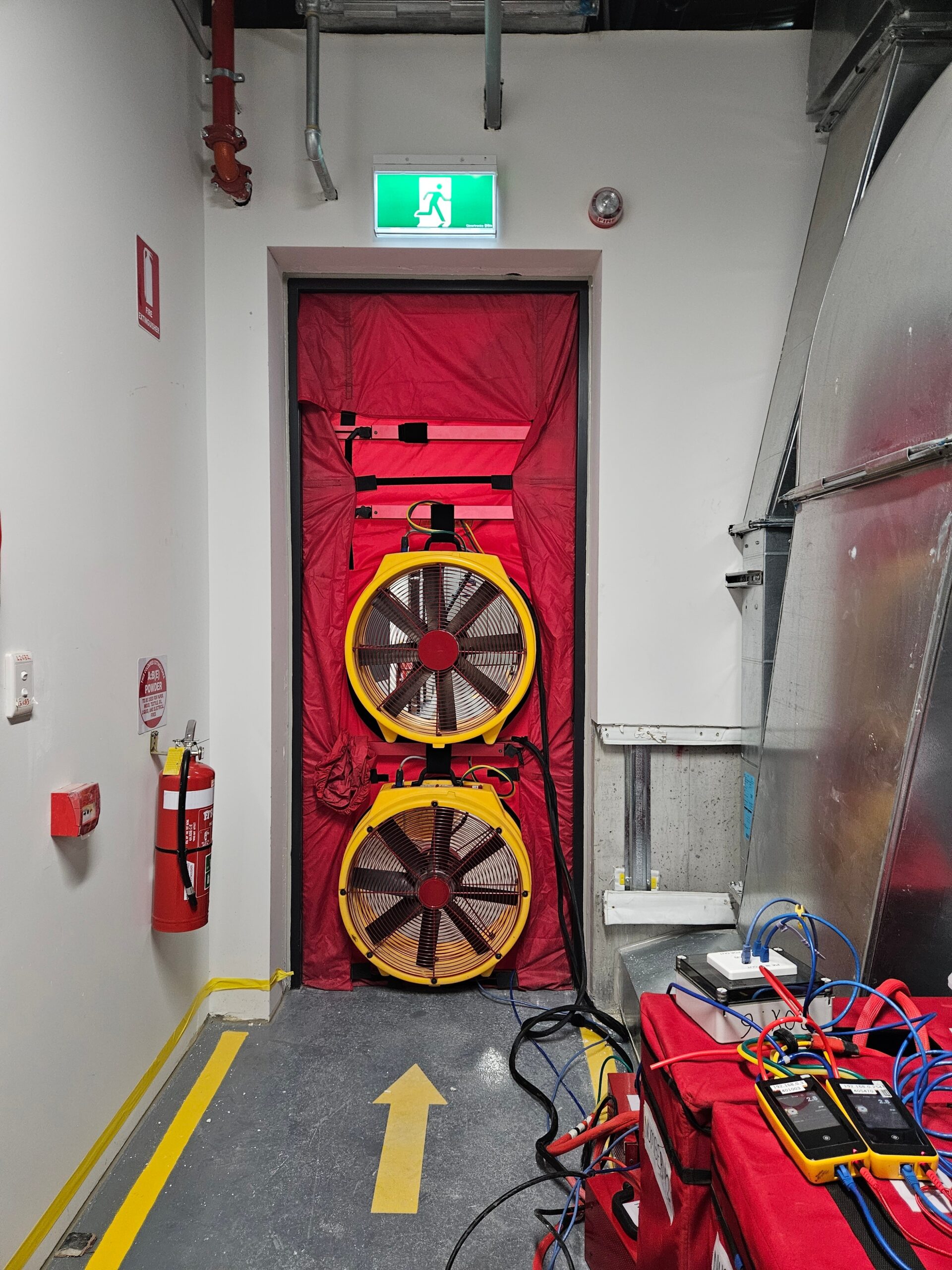 landing commissioning strategy encouraged in Green Star Buildings v1.
Ask any ESD consultant to list the most important aspects of an energy efficient commercial building, and near the top of the list will be air tightness/build quality.
Implementing airtightness can be more cost-effective and longer lasting than:
- Installing solar panels
- Upgrading to LED lighting
- Implementing a high-efficiency mechanical system
One of the major reasons why a building may fall short of its energy efficiency goals is due to higher than expected air leakage. The best way to ensure a building actually ends up airtight is to test it.
Air sealing introduces benefits for:
- Energy consumption
- Environmental impact
- Occupant comfort
- Lower maintenance
 There are changes coming up for the Green Star points associated with Air tightness/Blower door testing.
Common questions we love talking about…
- How much does an airtightness test cost?
- How much can a project save by air sealing?
- What’s a typical result for a project like mine?
- Should I use a blower door fan setup, or should I pressurise the building envelope with the HVAC system instead?
Efficiency Matrix has real world experience in testing and remediating some of the largest commercial buildings in Australia. We have consistently helped out clients meet and exceed their airtightness goals.
Click here for more information about the options for air tightness testing.


