
The Truth About Duct Leakage
Frequently Asked Questions (FAQ)
1. What capability of duct air tightness testing can Efficiency Matrix do?
Testing capabilities for builder’s risers (speedpanel/precast/blockwork/riser liner), plenums or sheet metal ducts.
250Pa – 3500l/s leakage
500Pa – 2500l/s leakage
1000Pa – 750 l/s leakage
2000Pa – 280l/s leakage
3000Pa – 100l/s leakage
Check out a video we did on Blockwork air tightness
2. Why is ventilation compliance not being met across the industry?
The core issue isn’t always compliance—it’s performance. The better question is: “Why are systems not operating as designed?”
Historically, compliance has been based on “deemed-to-satisfy” approaches, where manufacturers and installers follow prescribed methods, not necessarily outcome-based performance testing. In the past, only special buildings may prescribe pressure testing of ductwork by the mechanical consultants.
National Construction Code (NCC) 2019 Vol 1 J5.6 states:
Ductwork Sealing
Ductwork in an air-conditioning system with a capacity of 3000 L/s or greater, not located within the only or last room served by the system, must be sealed against air loss in accordance with the duct sealing requirements of AS 4254.1 and 4254.2 for the static pressure in the system.(i) apply to ductwork located within the only or last room served by the system; and
It is unclear if this clause includes the air leakage testing requirements of AS 4254.2 for all HVAC ducts. The NCC 2019 Guide to Building Code of Australia (BCA) Vol 1 come to the rescue.
The guide explicitly said the leakage test clause 2.2.4 of AS 4254.2 is part of the requirement.
3. Is poor duct sealing common, and where is it typically found?
Poor sealing is common in all types of ducts. Usually the larger the duct size, the more problems we expect to find. Our experience shows that most ductwork we have tested leaks between 8% to 18%, with some extreme cases leaking 35%+ in the initial test. It is also worth to note that these values are obtained from pure random sampling of ducts to be tested on the day or during a feasibility study for energy efficiency retrofit works. Advanced notice on which sections of ducts will be tested, generally yield better performance as contractors usually put in extra effort to seal sections of sample ductwork.
4. Why are ducts not being effectively sealed? Is it skills, knowledge of the issue or care?
There are lots of factors contributing to the poor sealing of ducts. Usually, the main issues are related to limited accessible workspace around ducts. Problems occur when ducts are installed too close to the underside of the slab or structure, which restricts the ability to install cleats near the centre of the duct joints. In some cases, the installer can put the cleat in place with telescopic tools, but accessibility issues disallow an inspection to understand how well the cleat is holding the joint together.
The other common issue is, not having enough room to install the custom pieces after all the standard sections have been installed, connecting all the ductwork to the riser. Contactors have to push the already installed ducts to the sides while slotting the custom piece in. This installation method can easily create situations where the foam seal on one side of the duct is “rubbed” off or rolled up. As a result, the seal ends up being not effective. Not enough margin/tolerance ends up leading to a situation where the contractor has to ’jam in’ duct pieces.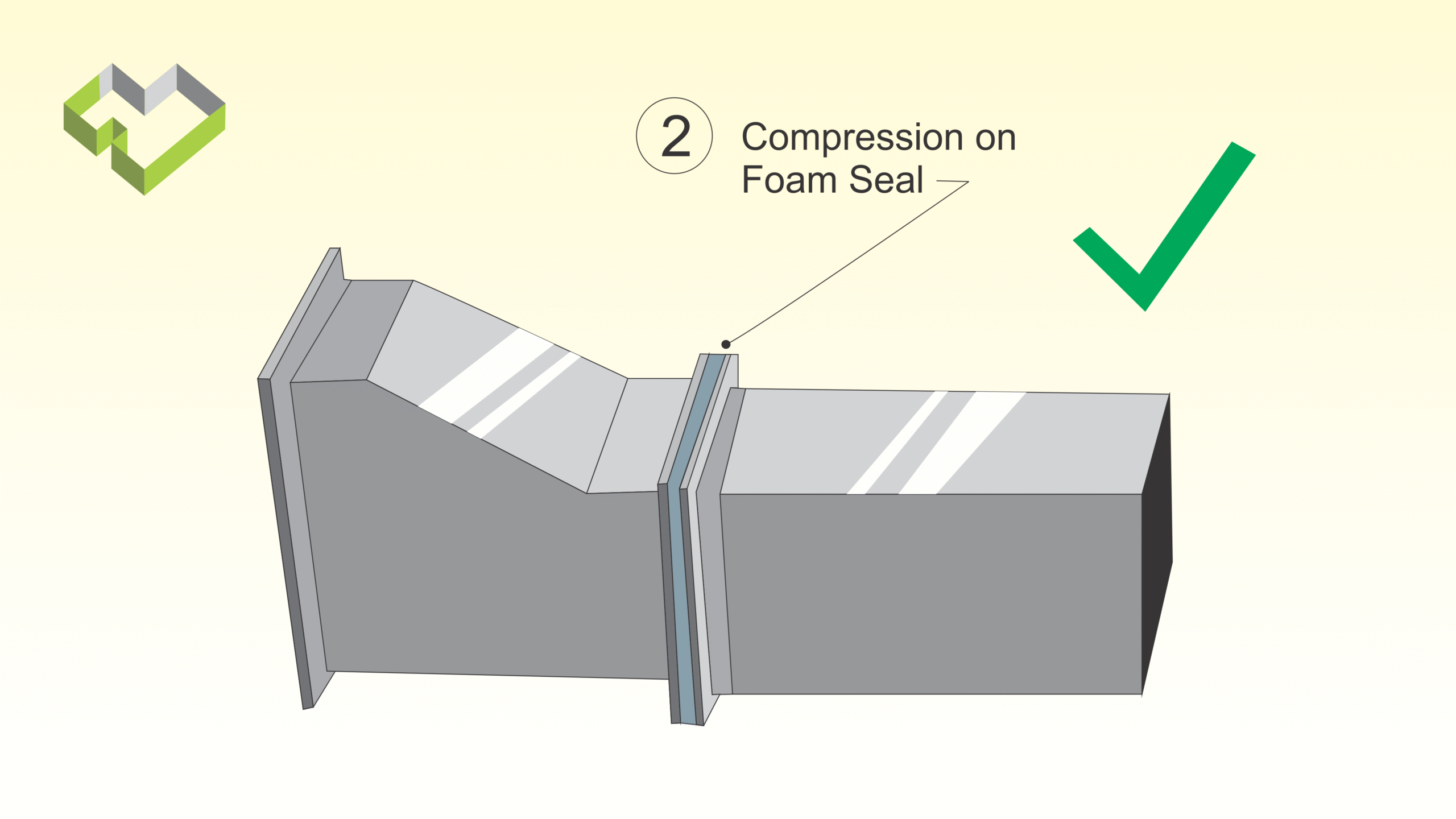
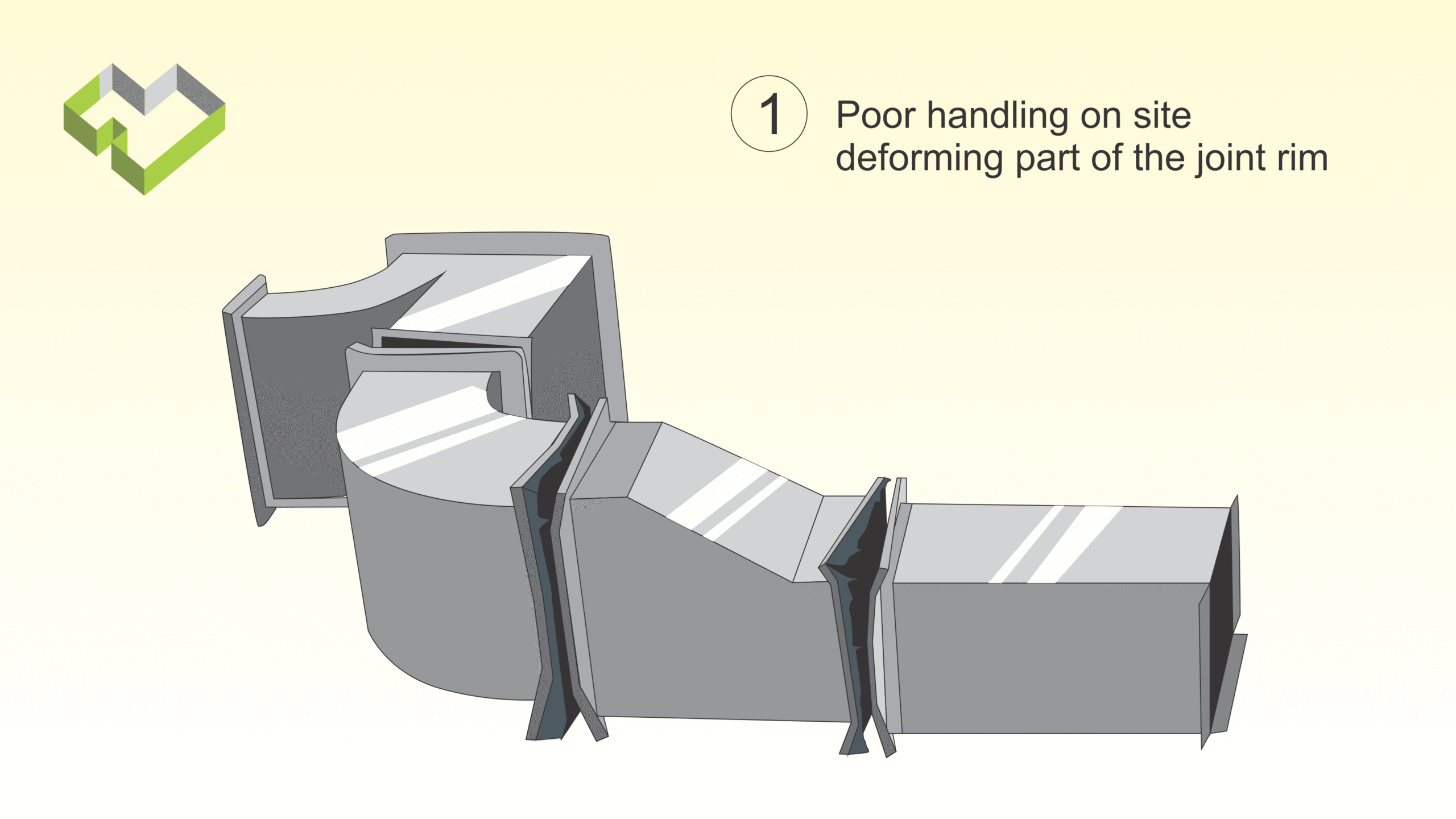
When ducts are in a subfloor, duct are damaged by trades walking on them. Improper transport and storing the duct usually ends up bending the corners of the joining rims or in some cases one side of the rim is deformed. These can easily create gaps that cannot be properly sealed by the typical foam seal used. In one instance, a gap caused by such deformation leaked 6% of the design air flow at test pressure.
5. Is the lack of enforcement contributing to poor practices?
The more likely issue is that the contractor did not receive feedback on non-optimum practices, thereby unknowingly carrying on the poor practices. The other reason is that the industry focuses on the volume of air being delivered at various outlets as a performance indicator for ducts. As long as the HVAC contractor meets the air delivery specified, it’s a job well done, regardless of the level of leakage. Sometimes the slight oversized air handler (safety margin) also reduces to incentive to improve duct sealing as the installers knows there is going to be enough slack.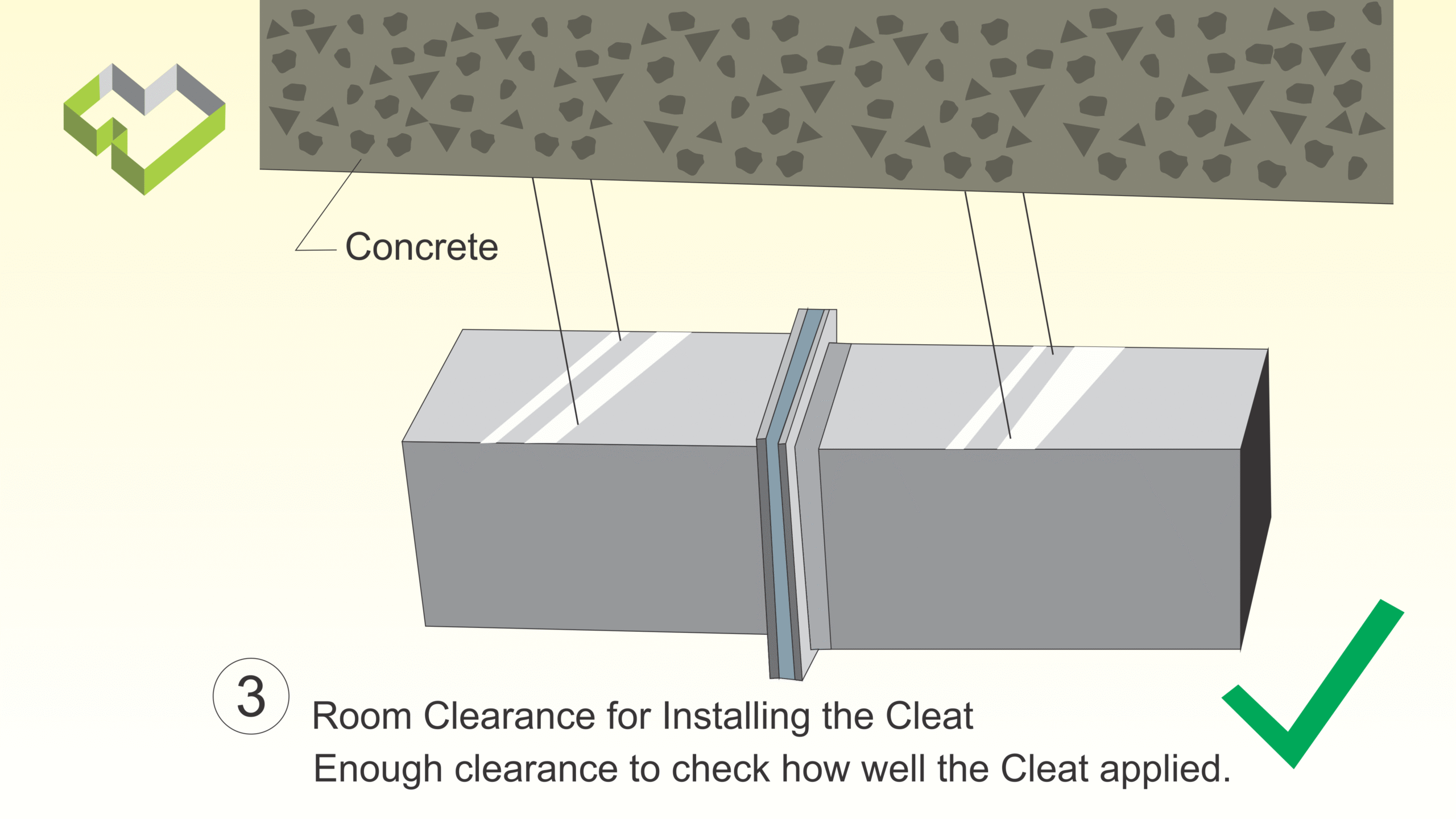
6. What does the NCC require, and how is duct sealing measured?
NCC refers to the AS 4254.2 2012 for rigid duct sealing. There is some confusion because it says that ducts in the very last room being served don’t have to be sealed. This made it unclear whether any duct pressure testing was required.
In addition, there are a few issues regarding details of the duct leakage test no being defined clearly.
AS 4254.2 2012 2.2.4
“Duct systems with a capacity of 3000 L/s or greater shall be tested for air leakage at a static pressure of a minimum of 1.25 times the calculated design operating pressure in the tested duct section. Leakage shall not exceed 5% of the design air quantity for the duct system.”
AS4254 calls for type-testing of at least10% of the system, including longitudinal seams, circumferential joints, floor distribution, riser and plant room duct, and each type of seam, joint and sealing construction. The standard does not indicate whether the 10% relates to total duct length, surface area or length to seams but overseas standards use duct surface area. Designers and contractors should agree as to which sections are to be tested having regard to design intent and practicability on site.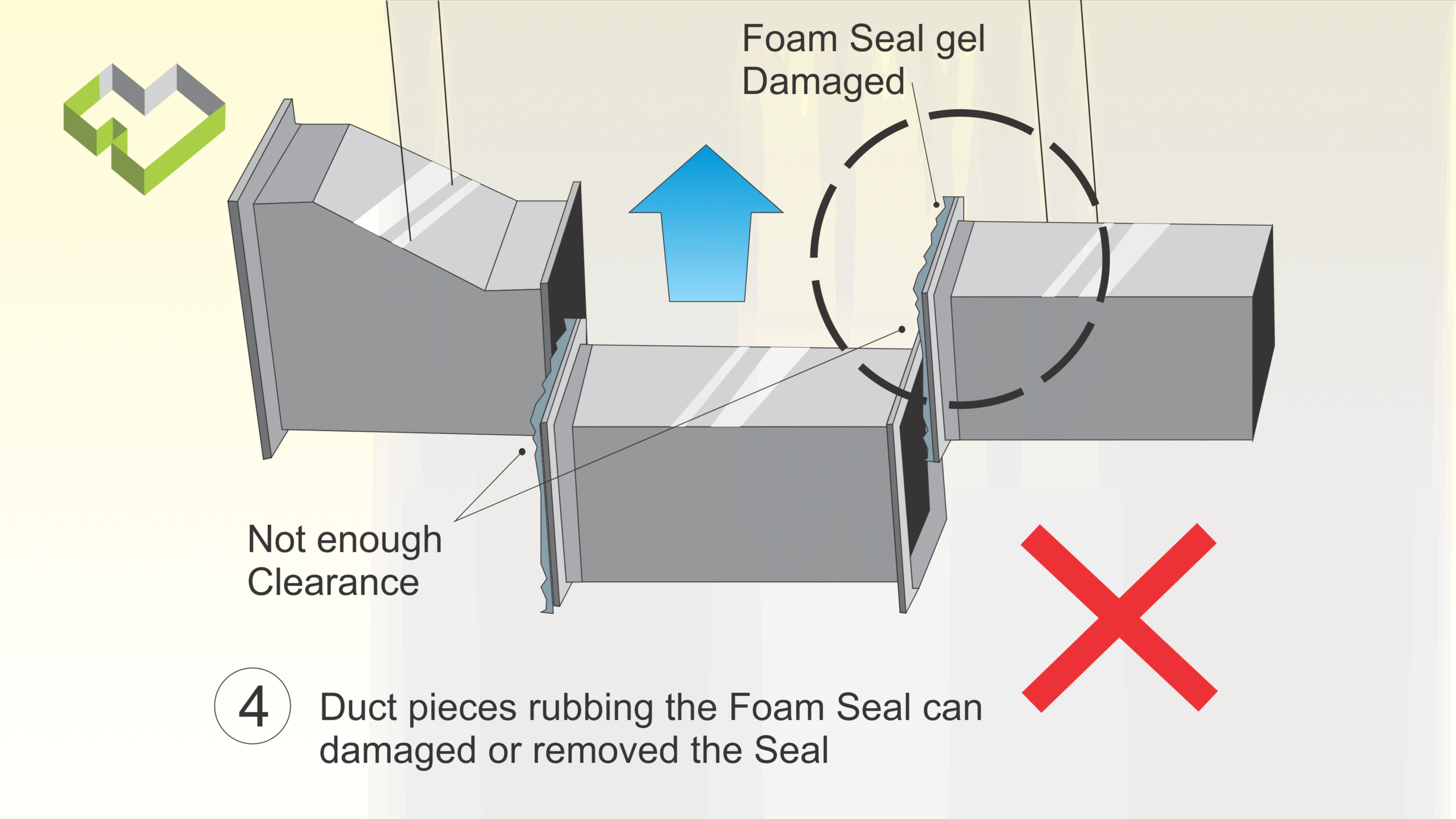
The standard does not define how to calculate the operating pressure of the test duct section. Another key issue is how to apportion the 5% system wide leakage allowance to the sample test duct sections. It is not a problem if the entire system can be tested at one go. In larger system where 1 AHU serving a number of floors, there is no guidance for the tester to divide the leakages to various sections of ducts. For example, a system serving 3 floors. It is logical to break up to test into 4-5 parts: Ducts in the plantroom (directly connected to AHU and Riser), ducts in riser, level 1 ducts, level 2 ducts, level 3 ducts.
They all can have different operating pressure due to the frictional loss along ducts and the number of outlets on each floor.
One possible method to address this is the arithmetic averaging of duct pressure and leakage allocation by surface area. This is simple method, though often underestimates the leakage in the plantroom and risers while overestimating at floor levels past the variable air volume (VAV boxes).
The other method you could use is pressure adjusted area weighting, where the operating pressure difference between various parts of the duct systems are taken into account. To use this method, a ‘pressure map’ along the duct system needs to be provided to the tester.
7. How should duct be sealed? What are the best methods?
The conventional method of combining foam seals in transverse joints and mastics can effectively seal the ducts. However, the inspection and verification of seal being applied can cause issues. Visual inspection can only do so much, especially when space is limited or when the seal is covered by other materials such as insulted ducts or attenuators. Pressure testing ducts can reveal the issues and pinpoint the leaks with the help of tracer smoke. In some cases, traditional method cannot be applied, such as sealed masonry risers. A more advanced solution is automated aerosol-based sealing, which internally pressurizes the duct and seals leaks from the inside.
8. What are the implications of leaking ducts (energy loss, exhaust air re-entering supply air duct)?
Despite the view expressed in AS 4254:2002, a few simple calculations suggest that there is reason for concern about the impact of duct leakage. Consider a typical air conditioning system in which the designer follows AIRAH DA09 [4] and assumes a supply duct leakage rate of 5%. To deliver the design air quantities to the spaces served, the fan must handle 1/0.95 times the sum of the room air quantities or 105.3% of the nominal air flow. Applying fan laws gives an increase in fan power of 117%, so the widely accepted leakage rate of 5% has added 17% to supply fan energy, for every hour the plant operates. At 10% leakage the extra fan energy is 37%.
But that’s just the beginning—duct leakage also affects the energy used by heating and cooling systems. The impact depends on where the ducts are located:
-
If the ducts are within the conditioned space, low leakage might not be a major issue because some lost air still contributes to heating or cooling.
-
If the ducts are in a return air plenum or unconditioned space, the leaked air offers no useful benefit. It simply circulates inefficiently, wasting fan energy and reducing return air temperature.
-
If the supply ducts are outside the conditioned space, like in a ventilated roof cavity, leakage results in direct energy loss. In this case, the 17% fan energy increase is compounded by additional losses in heating and cooling—and increased greenhouse gas emissions.
The analysis for return air ducts also depends on where the return air duct is located. If the duct is in the conditioned space, leakage has little or no effect since the air leaking into the duct is the air that would have been returned anyway. If the return air duct is outside the conditioned space, the effect is more pronounced.
For example, let’s say the system uses 15% outside air. If there’s a 5% leakage rate in the return ducts (from outside), this effectively increases outside air intake to 19.3%—a 28% rise in outside air load. For a typical Sydney cooling system, this could add 5% to peak cooling demand. It will have less effect on a VAV system with an economy cycle but more on a constant volume system with a lower percentage of outside air.
In summary a 5% leakage rate can contribute to the following:
- +17% fan energy use (supply side)
- +5% heating/cooling loss (supply ducts in unconditioned space)
- +5% extra load from return duct leakage pulling in outside air
→ Combined, this can easily add 10–15% to HVAC energy use and greenhouse gas emissions, depending on system type.
We do not have published data for the effect of duct leakage in Australian systems but there have been of a number of overseas studies dealing with the issue. One [5] estimated the heating energy wasted by duct leakage in Belgium at 15 GW.h (0.054 PJ) per annum and 0.75 TW.h ((2.7 PJ) per annum for the rest of Europe. Another study of VAV systems in large commercial buildings in California [6] calculated that, compared to “tight” duct systems (2.5% leakage), systems with 10% leakage had annual HVAC system operating costs 9 to 18% higher, while those with 5% leakage used 2 to 5% more energy.
Additional wastage occurs if supply and return air risers are collocated in the same structural riser shaft. This can cause short-circuiting, direct energy wastage and danger to HVAC control due to the miss matching of room temperature and return air temperature. The room will continue to call for cooling, but the return air sensor will be telling the chiller to reduce output.
Other symptoms such as poor distribution of air, uneven temperature across floor, and increased occupant complains are all related to leaky ducts.
9. How big an impact can this have on performance and longevity of the duct?
In humid areas, the leaks in supply ducts can result in condensation which accelerates the deterioration of the sheet metal. The same applies to kitchen exhausts where the humid air leaks to cool spaces inside or outside of the building.
10. How difficult and costly is retrofitting leaky ducts?
11. How can the industry improve its performance in this area?
-
Mandatory pressure testing
-
Feedback loops to installers
-
Better off-site duct fabrication
-
Improved on-site QA
-
Innovative joint design
-
Adoption of aerosolized internal sealing methods


